


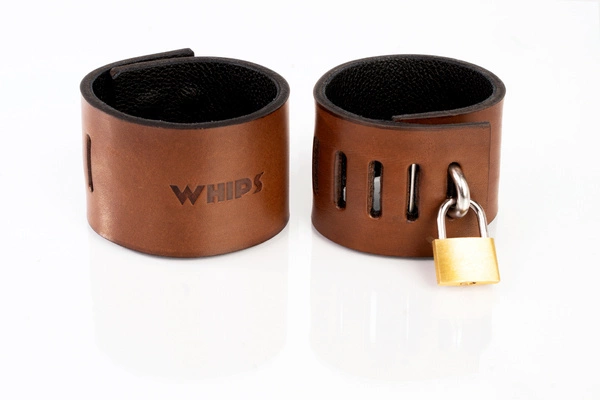


Brown Locking Cuffs Size L Primal Bond Whips
Primal Bond Shackles with Padlock – A Tool of Complete Immobilization with No Way Back
Not every relationship needs words. Not every restraint must be brutal. Sometimes, all it takes is a gesture, a material, and a decision. The Primal Bond Shackles with Padlock in the brown version are made for those who don’t seek compromise. This is not an ornament, not a gadget. It’s a closure that works – every time precision, durability, and the symbolic end of choice matter.
This is a product for the conscious. For those who know a tool doesn't need to be liked. It needs to function. It needs to hold. And not let go until a decision is made to unlock it. These shackles leave no room for chance. No buckle – just holes. No clasp – just a chain. No adjustment – just form. No backup option – just a padlock. Simple. Intentional. Permanent.
No Compromise – A Design That Allows No Trials, Only Decisions
The design is based on clarity. A 6 cm wide leather strap, thick enough not to yield under tension. Cut-out holes – allowing the chain to pass through with no slack. No adjustment mechanism – everything is fitted at the moment of application. If it’s meant to hold, it has to truly hold.
Once the padlock clicks shut, everything becomes irreversible – at least within the agreed scene. The restrained person has no influence on what happens next. Only the key can reverse the decision. And only one person holds it.
Brown Leather – Raw, Durable, Functional
Natural cowhide was chosen not for looks, but for its properties: durability, resilience, resistance to wear, and natural adaptability to body shape. The outer layer – stiff with a raw texture. The inner – soft to prevent chafing. The leather retains memory – after a few uses, it conforms to the user's anatomy but doesn’t lose its form. Like every relationship – tough on the outside, but willing to cling to the body, given time.
The brown shade is no accident. It’s the color of workshops, tools, and daily action. It doesn’t scream. It doesn’t shine. It simply is – and does its job. It evokes belts, harnesses, construction. Exactly how a utilitarian material should be: neutral and reliable.
A Material That Doesn’t Let Go – but Stays Close
This is not about brutality. It’s about certainty. These shackles can be put on tight – but they won’t chafe. They can be worn long – but won’t wear the skin. The design is meant to block movement without causing pain – unless that’s the intention. But nothing stops you from changing that intention. Just pull tighter, hold longer, pause when it’s too much.
Chain and Padlocks – The Physical Seal of Dependency
The set includes two key components: a steel chain and two padlocks with keys. The chain is heavy, resilient, unmovable. It’s made to hold. The padlocks are compact but unbreakable without force. No button, no emergency release. Click – and done.
It’s not just a physical closure. It’s a ritual one. The moment the padlock snaps shut, the restrained person knows the situation has changed. It’s no longer about will – it’s about fact. You can build a whole scene around that, or say nothing at all. Because the sound of the lock says enough.
Scene in Use – Restraint as a Tool of Communication
The shackles can be used in many configurations. To bind wrists. To tie ankles. To lock the body in a specific position. To attach to an anchor point – ring, beam, bed. They can be applied front or back. Sitting, standing, kneeling. The system always functions the same – regardless of position.
This is a tool that doesn’t need an introduction. Presence is enough. Being locked in shifts posture, breathing, mindset. You don’t have to instruct. Just close. And let the situation evolve.
Fit and Range – One Tool, Many Possibilities
The adjustment range is 22–27 cm. Enough to fit most wrists and ankles, regardless of body type. The leather isn’t stretchy – but it doesn’t need to be. Fit is achieved by selecting the hole and chain length. Not by buckle. Not by looseness. By precision.
Once you put it on, you’ll understand – it’s not about movement. It’s about staying in place. And staying exactly where it should be.
The Psychology of Restraint – A Relationship Built on Silence and Stillness
When the padlock clicks shut for the first time, it changes more than just the physical state. It changes the mental one. The restrained person feels the weight of dependency. They feel limitation – but also structure. The shackles are a framework. Not just restriction of freedom – a directional cue: this is where your choice ends. Beyond this – someone else’s will begins.
For the dominant, this is a tool of responsibility. For the restrained – a challenge or a relief. Depending on the agreement. But it is never neutral. It always means something.
Safety – Total Control Requires Full Presence
No quick release means one thing: you must be present. The key must be within reach. The restrained person – under observation. Safety signals – agreed in advance. When you lock, you take responsibility. Not just for the body, but for everything that happens to it while restrained.
Monitor tension, circulation, reactions. If something changes – respond. This isn’t gear for spontaneous gestures. It’s a tool for those who know what they’re doing. And why.
Maintenance – A Tool That Serves, If Cared For
After each session, wipe the leather with a dry, soft cloth. Do not use water or detergents. Every 3–4 weeks, apply a thin layer of colorless leather balm – to prevent drying, cracking, or stiffening. Store flat, away from heat and light.
Wipe the chain and padlocks dry and store separately. You can protect them with a thin layer of technical oil. Stored properly, they’ll work for years – no jamming, no slack, no deterioration.
Technical Specifications – Primal Bond Shackles with Padlock (Brown)
- Color: deep brown
- Strap width: 6 cm
- Adjustment range: 22 – 27 cm
- Material: natural cowhide leather, double-layered
- Inner finish: soft full-grain leather
- Closure: steel chain + 2 padlocks
- Application: wrists or ankles
- Included components: chain, 2 padlocks, 2 keys
- User level: intermediate and professional